
Stop Prompting an LLM to Pick a Move: Decision Models Now Run Locally in Razer AIKit v0.8.0
Stop Prompting an LLM to Pick a Move
Decision Models Now Run Locally in Razer AIKit v0.8.0
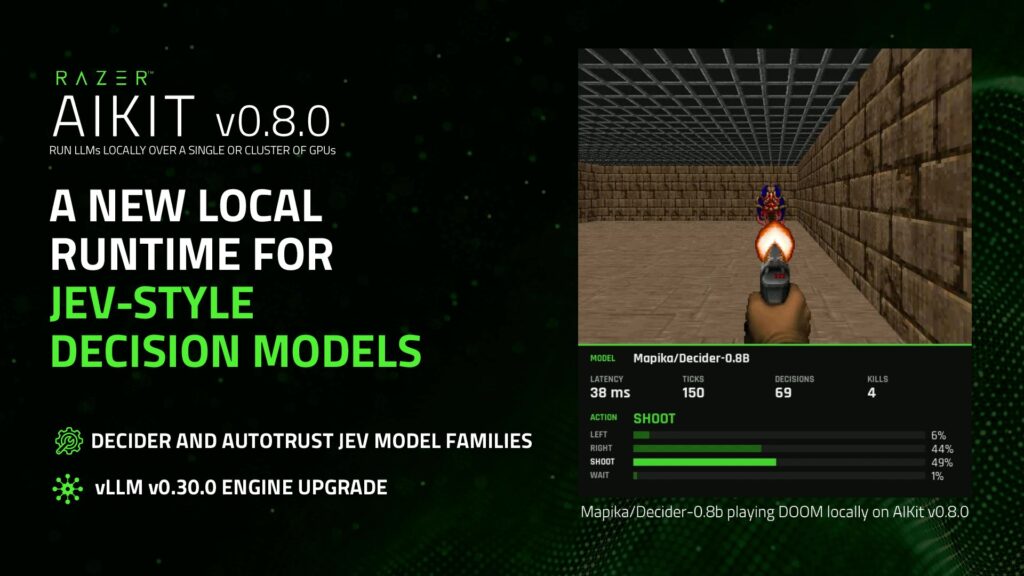
If you’ve built an agent loop around a general-purpose LLM, you’ve probably hit this wall: the model is capable but is unable to meet the latency requirements of real-time systems. Game agents, robotics controllers, and workflow routers don’t need paragraphs. They need a structured answer, now.
Razer AIKit v0.8.0 brings a new kind of decision-making to local AI with support for System One decision models: compact models built for fast, structured decisions rather than text generation. The update introduces two open-source model families, Mapika Decider and AutoTrust Jev, that can run locally and turn context into actionable outputs, from probabilities and scores to choices among predefined options.
Rather than generating paragraphs of text, these models get straight to the point. In gaming, for instance, a model could estimate whether a player is more likely to attack or retreat, helping developers build NPCs that react more intelligently to unfolding battles and adapt to gameplay in real time. For developers, structured outputs also mean less processing overhead and a more direct path from model predictions to in-game logic.
WHY LATENCY IS A DESIGN CONSTRAINT
Take the original DOOM, which runs its game logic at 35 ticks per second. That leaves roughly 28 ms per tick to observe, decide, and act. Research platforms like ViZDoom have used DOOM for this reason for years: it is a compact, fast-moving testbed for agents that must decide under time pressure.
For our evaluation, we run the game at 30 ticks (30 FPS) per second, giving the model just 33 ms to perceive the environment, make a decision, and execute an action.
So we put the new models in that seat.
THE TEST: DOOM ON A LAPTOP
We ran the simulation on a Razer Blade 18 with an NVIDIA GeForce RTX 4090 Laptop GPU (16 GB VRAM), comparing three setups. We used the smallest Mapika model; the AutoTrust Jev models were not part of this benchmark.
| Model | Deployment | Role |
|---|---|---|
| Mapika Decider 0.8B | Local via Razer AI Kit | Compact, specialized decision model |
| Qwen 3.5 0.8B | Local via Razer AI Kit | General-purpose language model |
| TypeSafeAI/Jev | External cloud API | Cloud-hosted decision model |
We measured decision latency and practical responsiveness during live play, alongside how effective the chosen actions were. The aim wasn’t to crown the fastest model, but to find which setup made useful decisions consistently within the game.
WHAT WE SAW
- Mapika Decider 0.8B (local): Best overall. Responsive and accurate enough to keep up, with choices that held up as the scene changed.
- Qwen 3.5 0.8B (local): Even though it’s faster than Jev, it had only a moderate response time, with weaker action choices and the weakest overall play.
- TypeSafeAI/Jev (cloud): Stronger decisions, but API round-trip latency made it unsuitable for continuous real-time play.
| Model | Observed result | Avg. Decision Latency (ms) | Gameplay metric (kills over 450 ticks) |
|---|---|---|---|
| Mapika Decider 0.8B | Fastest; best overall play. | 40 | 12 |
| Qwen 3.5 0.8B | Moderate latency; weaker decisions. | 90 | 3 |
| TypeSafeAI/Jev | Stronger decisions; cloud latency too high | 270 | 5 |
THE TAKEAWAY FOR BUILDERS
The fastest model won, but it wasn’t the smartest. TypeSafeAI/Jev made the strongest decisions but answered too late to act on, and Qwen was both slower than Mapika and less accurate. Mapika won because it made good decisions fast enough to act on, with no network round trip in the way.
For real-time AI, a decision is only as good as the moment it arrives.
Running locally also means no per-call API costs, no rate limits, and no dependency on connectivity, all on hardware you may already own.
WHAT ELSE IS IN RAZER AIKIT V0.8.0?
- Support for System One decision models: Mapika Decider (0.8B / 2B / 9B) and AutoTrust Jev (9B / 27B / 27B-VL)
- vLLM engine upgrade to v0.30.0
Curious to find out more about Razer AIKit? Check out the GitHub Repository.
© 2026 Razer Inc. © 2026 IndividuAI Inc. All rights reserved.


